You need to thank one man for your current existence – a Russian.
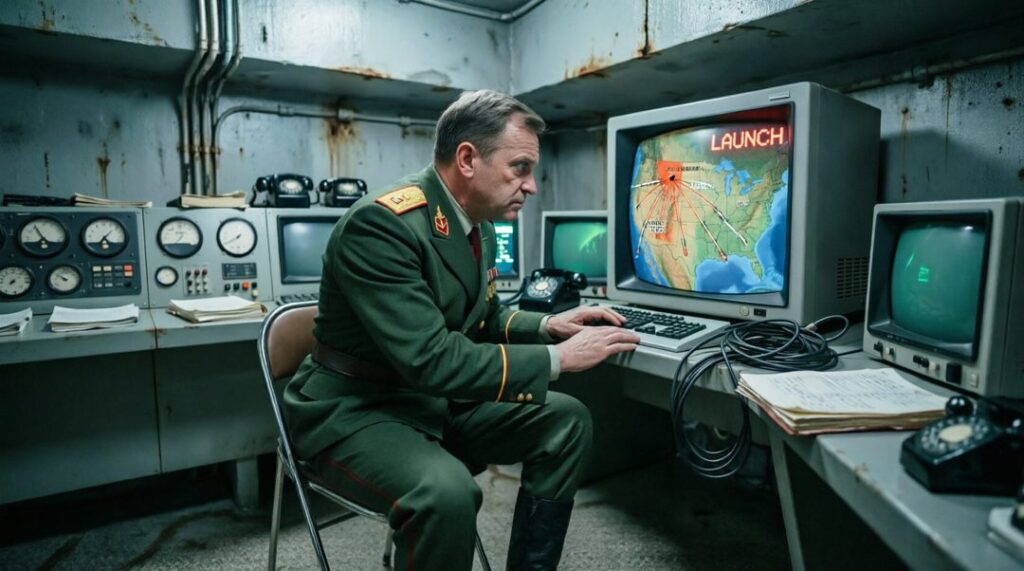
On September 26, 1983, Stanislav Petrov was the duty officer at Serpukhov-15, the Soviet command bunker for early warning satellites. Just weeks after serious NATO actions, his Oko satellite system reported that the United States had launched five intercontinental ballistic missiles from Montana. Against all protocol, Petrov reasoned that a genuine American first strike would involve hundreds of missiles, not five, and that the lack of supporting ground radar data indicated a false alarm. He decided not to report the attack up the chain of command to Soviet General Secretary Yuri Andropov. If he did it would almost certainly have triggered a full Soviet nuclear retaliation against the United States. For 23 agonising minutes, he waited for incoming explosions; when none came, he knew he had been right. He was not supposed to consider ‘if he was right.’
Rather than being celebrated as a hero, Petrov was reprimanded by the Soviet military. An official investigation uncovered a software flaw in the satellite—sunlight reflecting off clouds had mimicked a missile plume. But the army preferred to blame human fallibility rather than admit the failure of its expensive defence system. Petrov was publicly criticised for “improper documentation” in his logbook and for failing to follow proper escalation procedures. The stress contributed to a nervous breakdown, and he took early retirement in 1984. The full story remained classified for years, and Petrov lived out his life largely unrecognised in Russia, though he later received international honours. He died in 2017, the man who arguably saved the world by trusting his own common sense.
Most of us will never face nuclear Armageddon. But the same dynamic plays out every day, in hospitals, prisons, banks, and HR departments. Technology provides correct data. Humans fail to interpret it correctly, fail to verify it, fail to pause before acting. The consequences range from lost job opportunities to catastrophic harm.
This article is about those failures. Not computer glitches. Not database errors. It is about human errors. The kind that happen when we trust a screen without question, assume bad faith in others, or race to a conclusion because stopping to check feels too slow.
We are more often the weakest in the chain; not the technology. On top of that our jobs may be at risk if we do not act where policy directs.
A clinical case with serious consequences
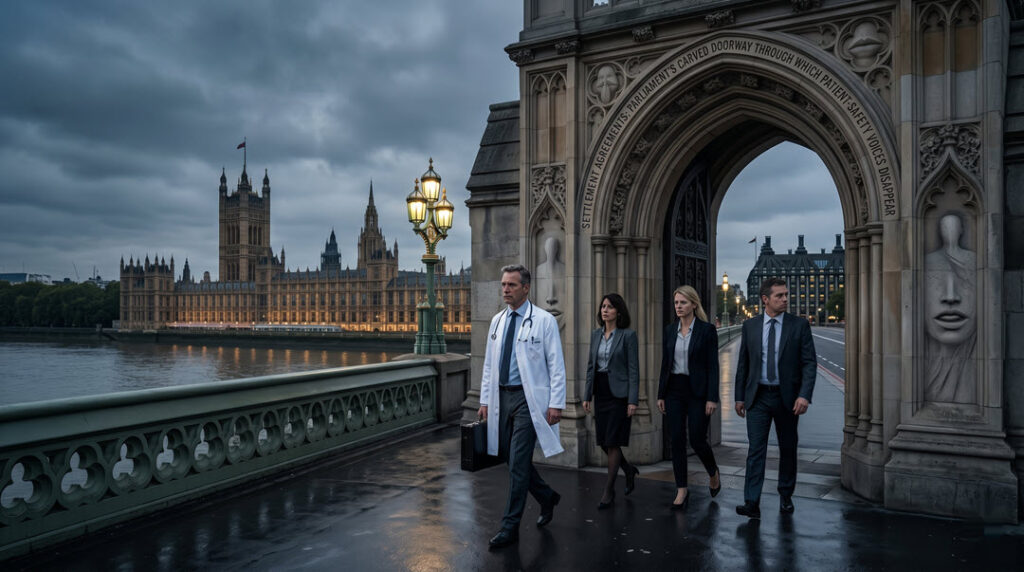
Now a serious case recently in the UK: A child; a prescription; a mother accused of sexually abusing her 5 year old daughter. How does that sequence happen?
In 2024, a five-year-old girl was prescribed a Clotrimazole vaginal pessary by a physician associate. This treatment is categorically unsuitable for a child of that age. No medical knowledge required. The mother questioned it immediately, including the size of the pessary, but was reassured by someone she believed was a doctor.
She trusted that reassurance. She inserted the pessary. The child suffered bleeding, screaming pain, and burning in the surrounding skin area.
At an out-of-hours appointment, the child was still in agony and begged the doctor not to examine her internally. The doctor interpreted these symptoms—pain, bleeding, fear of internal examination—as possible signs of sexual abuse. A safeguarding referral was made against the mother.
A consultant later confirmed the truth: the injuries were caused entirely by the inappropriate prescription, not by abuse.
The Parliamentary Health Ombudsman found multiple failures:
- The physician associate lacked the knowledge to know the prescription was unsafe.
- The supervising GP did not review or sign it off.
- The pharmacist dispensed a vaginal pessary for a five-year-old without questioning it.
The technology—prescribing systems, pharmacy databases—correctly showed the child’s age, the drug name, and the dosage form. The data was accurate. The humans failed at every step.
The mother later said she felt “huge guilt” for trusting what she thought was a doctor. She asked how anyone is meant to trust healthcare professionals when a prescription passed through three clinicians and none stopped it.
You have to wonder – ‘what on earth happened there?’
Historical examples where technology was right, Humans Were Wrong
History is full of cases where technology provided correct data as designed to do, and humans — through cognitive bias, fatigue, obedience to hierarchy, or simple failure to pause — made catastrophic errors.
Below are several well-documented examples. In each case, the technology worked. The databases, sensors, or software displayed accurate information. The failure was entirely human.
Challenger, 1986 – Engineers had data showing O-rings would fail in cold weather and recommended against launch. NASA managers overruled their evidence based data. The shuttle exploded. Seven died.
Iran Air Flight 655, 1988 – A US Navy cruiser’s radar correctly identified an approaching aircraft. Under combat stress, operators misclassified it as hostile. The crew shot down a civilian airliner. 290 died.
Barings Bank, 1995 – Internal risk systems generated accurate warnings about unauthorised trading. Managers, overconfident in a star trader, ignored them. The bank collapsed.
Mars Climate Orbiter, 1999 – Software produced correct data in metric units. Ground crews expected imperial units. No one checked the mismatch. A $125 million orbiter was lost.
Air France 447, 2009 – Iced sensors disabled the autopilot, leaving correct backup instruments. The pilot fixated on a single erroneous reading and ignored valid data from other screens. 228 died.
Deepwater Horizon, 2010 – Pressure readings correctly showed gas in the well. BP management overruled crew warnings to delay testing. 11 died. The Gulf of Mexico was polluted for months.
There was no cut-off at 2010. I could find 100 more similar examples to date. The point is the same.
In every case, the screen told the truth about what the devices ‘knew’. The humans did not listen, did not pause, did not verify. And the consequences ranged from financial collapse to mass casualty. Petrov was the exception and he was made a scapegoat.
Categorising human errors
What kinds of human errors are known? Below is a partial list. It is not exhaustive, but it captures the most common failures that occur when technology is working correctly.
Ignorance / Lack of knowledge – The human does not know what the data means or what action is required. The screen shows the facts. The human lacks the training to interpret them.
Distraction / Cognitive load – The human is tired, interrupted, or overloaded. Attention drifts. A critical piece of data is missed.
Confirmation bias – The human already believes something. They seek or favour data that confirms that belief and ignore data that contradicts it.
Authority bias / Obedience to hierarchy – The human defers to a perceived authority figure rather than acting on the data before them. A junior sees an error. A senior dismisses it. The junior stays silent.
Overconfidence – The human overestimates their own ability. They dismiss data that contradicts their judgment because they trust themselves more than the screen.
Routine / Habit / Automation bias – The human follows routine procedure even when the data indicates an exception is needed. They are on autopilot. They do not stop to think.
Groupthink / Social pressure – The human goes along with a group decision rather than raising dissent based on the data. No one wants to be the outlier.
Time pressure / Urgency bias – The human prioritises speed over accuracy. They skip verification steps. They act before they think.
Attribution error – The human assumes a negative outcome is another person’s fault rather than a system or data issue. They blame the individual, not the process.
Fatigue / Sleep deprivation – Prolonged wakefulness impairs decision-making as much as alcohol. The human sees the data but does not process it correctly.
Fixation / Tunnel vision – The human locks onto one problem or one piece of data and ignores everything else. The rest of the screen or other screens might as well be blank.
Over-trust in automation – The human assumes the machine is infallible and stops monitoring it. The screen is correct. The human is not observing and thinking. Tired or burnt-out people avoid cognitive load.
Under-trust in automation – The human assumes the machine is unreliable and overrides correct data. They act on instinct instead of evidence. But this was not Petrov. It was more the roots of the Challenger disaster.
Each of these errors is human, not technical. And most of them share a common feature: they happen fast. The pause—the act of stepping back, questioning, verifying—is what interrupts them. Petrov paused. In the examples above, no one did.
The Pattern: Cascading human failures
Single human errors are survivable in low stakes situations. A single spelling error by itself is very unlikely to sink a ship. A moment of distraction does not always kill. What turns small failures into disasters is the cascade: error upon error, each one left uncorrected by the next human in the chain.
Imagine a simple sequence. Human A makes a data entry error. The system, working correctly, returns a negative result. Human B sees that negative result, does not question it, and passes it up the line. Human C, under time pressure, accepts the report as truth and makes a decision. Human D, trusting Human C, acts on that decision without ever seeing the original data.
At no point does any human pause to ask: “Does this make sense? Could there be a mistake? Can we check the source?” Nope – we in the era where there is a ‘need for speed.’
Each human assumes the previous human was competent. Each human treats the data on their screen as reality. Each human adds a small layer of confirmation: “If it were wrong, someone would have caught it by now.”
That is the cascade. It is self-reinforcing. The more people who have handled the data without detecting an error, the more trustworthy it appears to the next person. Errors become facts. Assumptions become certainties.
The cascade does not require malice. It does not require gross incompetence. It requires only ordinary human limitations—fatigue, distraction, deference to authority, time pressure, and the simple cognitive ease of believing what is in front of you.
Breaking the cascade requires only one person to pause. One person to ask: “Let me check.” One person to be the exception. Petrov was that person. In many real-world failures, no one is.
Why we blame computers
Brief argument: blaming “computer error” is easier than examining human processes. It protects individuals, organisations, and hierarchies. But it also guarantees repeat failures. The computer is a convenient scapegoat.
When something goes wrong, we look for a clean explanation. A computer error is clean. It is impersonal. It does not require us to examine messy human dynamics like fatigue, bias, hierarchy, or fear. We can point at the screen and say, “The system got it wrong.”
This is psychologically convenient for several reasons.
- It protects individuals. If the computer made the error, then no single person is responsible. The HR manager who acted too quickly, the manager who overruled the engineer, the doctor who misread the symptoms—all are off the hook. The fault lies with the machine.
- It protects hierarchies. Organisations do not want to admit that their training, culture, or supervision failed. Admitting human error at multiple levels invites scrutiny of processes, promotions, and power structures. Blaming a software glitch invites a patch.
- It satisfies our cognitive bias toward simple causes. Complex cascades of human failure are hard to narrate, hard to investigate, and hard to prevent. “Database error” is a single phrase. It fits in a headline. It closes a file.
- It aligns with a deeper cultural story: technology is powerful but fallible, humans are victims of its flaws. This story lets us off the hook. We are not the weak link. We are the ones let down by our tools.
But this story is usually wrong. The technology, in most well-documented failures, worked exactly as designed. The databases returned correct matches. The sensors sent accurate signals. The screens displayed the right data. The error was not in the machine. The error was in the human who trusted it without question, or ignored it without reason, or acted on it without verification.
Blaming the computer is a form of psychological displacement. It takes the error out of the messy, accountable, uncomfortable realm of human decision-making and places it into a clean, neutral, non-culpable system. It feels better. But it guarantees that the same error will happen again, because the real cause was never addressed.
The machine is rarely the weakest link. Blaming it is just the easiest way to avoid looking at ourselves.
What can be done?
This is not a checklist. It is not a set of instructions. It is simply a few things worth considering, drawn from the patterns above.
The pause.
Before acting on any piece of data—especially data that leads to a negative conclusion about someone else—pause. A second of hesitation costs nothing. It is the difference between Petrov and everyone else.
The question.
Ask yourself: “Could this be wrong?” Not because the data is likely wrong, but because assuming it is correct closes the door to verification. A single question can break a cascade.
The source.
If the data came through an intermediary, consider going to the original source. Direct verification is slower. It is also more reliable. The HR manager in the earlier story did not call the clearance officer. That was the error.
The evidence.
If someone asserts something you cannot immediately verify, ask them for their evidence. Most people keep records. Most people will share them if asked. Assuming bad faith is faster. It is also usually wrong.
The chain.
Recognise that you may be one link in a longer chain. The report you receive may already contain errors introduced by previous humans. Do not assume competence upstream. Do not assume error either. Simply check.
The computer.
Remember that the screen shows what it was told. It does not know truth. It knows data. The difference matters.
The apology.
If you acted on bad data and harmed someone, apologise. Not because it undoes the harm, but because silence compounds it. The mother in the clinical case received no apology from the clinicians who failed her. That is its own failure.
None of this guarantees safety. Humans will remain fallible. Cascades will still happen. But the cost of pausing is small. The cost of not pausing can be enormous.
Coda
Petrov sat alone in a bunker, watched a screen turn red, and decided not to end the world. He did not trust the machine. He did not trust the procedure. He trusted his own uncertainty and common sense. He paid for doing the right thing!
But in recent years the decreasingly common human act is the pause; the question and the refusal to pass on errors.
Every day, in hospitals and offices and control rooms and cockpits, other people face screens with smaller consequences than Armageddon. On their treadmills with a need for speed, they do not pause. They do not question. They trust the data, trust the chain, trust that someone else would have caught the mistake by now.
Not uncommonly that leads to someone getting hurt. A mother accused of sexually abusing her child. A candidate replaced. A bank going bust. A plane crashing.
The screen is not usually the problem.
The problem is the human who forgets they are human. Who forgets they can pause. Who forgets they can ask one simple question before it is too late.
The next time you look at a screen and it tells you something that matters, is conflicting in some way or it doesn’t make sense—there is nothing wrong with taking a few seconds to think. You are not Petrov but could be in a chain of responsibility for lives and human well-being. You could pause and ask yourself: what would Petrov do?