Introduction
A consultant anaesthetist on a busy NHS list repeatedly over months raises concerns about chronic understaffing and the resulting risk to patients. Suddenly she is called to an HR meeting and offered “a package” to leave. Sign the document, she is told, and you will receive a substantial payment in return for waiving your employment rights and agreeing never to speak about what happened. This is hypothetical but not too far from reality.
Some clinicians will recognise this scenario. In hospital corridors and union offices it is often referred to, bluntly, as a “gagging order”, or an “NDA exit”. In law it has a more precise name: a Settlement Agreement (SAG).
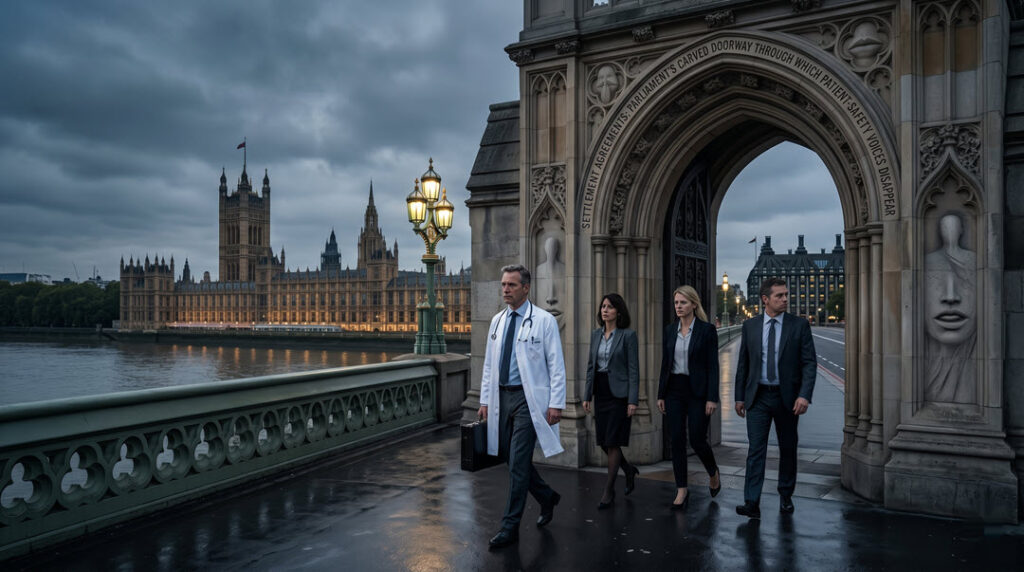
A SAG is the mechanism Parliament carved out of the general rule that you cannot contract out of your statutory employment rights. It allows an NHS Trust to pay a clinician to waive claims for unfair dismissal, discrimination, whistleblowing detriment and other protections, provided the agreement is in writing and the clinician has received independent legal advice. Once signed, the clinician usually disappears from the system, bound by indefinite confidentiality.
The same legal tool once silenced the late Paul Moore. In 2004, as Head of Group Regulatory Risk at HBOS, he warned the board that aggressive sales targets and weak risk controls were storing up disaster. He was dismissed and signed a compromise agreement (the predecessor of today’s SAG). Four years later HBOS collapsed. The taxpayer provided a £20.5 billion bailout — one of the largest corporate rescues in UK history. An official investigation confirmed Moore’s warnings had been “entirely correct”. The individual settlement payment he received has been estimated at around £500,000. No director was fined or banned. What happened to Moore is a potent illustration of how the carved door works.[1]
The NHS has no central register of SAGs. We do not know how many doctors, nurses or other clinicians who have raised patient-safety concerns — or were about to — have been paid to leave. We do not know whether those who were moved on were right to have repeatedly raised concerns, or the costs to the public purse.
The legal mechanism in plain English
At the heart of UK employment law is a protective rule: employees cannot sign away their statutory rights. Parliament created a narrow exception — the SAG. For the agreement to be valid the clinician must receive independent legal advice from a qualified adviser who carries professional indemnity insurance. The agreement must be in writing and relate to specified claims.
In practice the Trust almost always pays for this “independent” advice, caps the fee at £350–£500 plus VAT, and pays the bill directly. The adviser therefore faces an obvious structural tension: professional duty to the clinician versus the knowledge that repeat work from the Trust depends on keeping the employer satisfied.
Since 2013 employers have had an additional tool: the “protected conversation” under section 111A of the Employment Rights Act 1996. A Trust can raise the possibility of a settlement package even before any formal dispute exists. Anything said in that conversation is inadmissible in an ordinary unfair-dismissal claim, provided basic ACAS guidance is followed. The protection does not extend to discrimination or whistleblowing claims, but once a valid SAG is signed those claims are waived anyway.[2]
The law therefore gives Trusts a lawful, regulated route to buy finality and silence. The clinician receives money and leaves; the Trust avoids public examination of its conduct and any risk of future claims. For many NHS staff this has become the quiet exit route when patient-safety concerns, capability issues or cultural clashes arise.
The hidden risks doctors face
Several features make the deal far riskier than it first appears.
The confidentiality clause is the most powerful. In almost every SAG the obligation has no expiry date. The clinician is barred, for life, from disclosing the agreement, the payment, the allegations made, or the Trust’s reasons for wanting them to leave. Statutory exceptions are narrow. The Victims and Prisoners Act 2024 (effective 1 October 2025) voids clauses that prevent reporting a crime to the police — but only for agreements signed on or after that date.[3] Whistleblowing to regulators remains legally protected, yet many clinicians will fear repayment demands or legal action. The payment, the allegations and any internal investigation findings stay hidden forever. Future colleagues never learn whether the doctor who spoke up was right.
There is no statutory cooling-off period. The ACAS Code recommends at least ten calendar days, but the recommendation is not binding. Trusts can present a verbal offer with a 48-hour deadline and still comply with the law.[4]
The data black hole
No one can quantify anything related to SAGs. There is no central NHS or government register. Freedom of Information responses from individual Trusts produce only patchy snapshots — often “fewer than five” or low double-digit numbers per year. [5] We have no national picture. It is a true data blackout. The system Parliament designed deliberately does not collect or publish this information.
HM Treasury ultimately backs the Clinical Negligence Scheme for Trusts, which carries a provision of more than £60 billion. [6] It is impossible to know how many CNST claims arose from patient-safety concerns that were raised and then swallowed by the black hole. The preventable causes of this enormous public liability remain entirely invisible.
Reforms vs reality
Over the past decade several changes have been presented as restrictions on SAGs and confidentiality clauses. In practice they are narrow.
The most publicised is the NHS England policy on non-disclosure agreements announced in 2024. NHS England instructed Trusts to stop using confidentiality clauses in whistleblowing or patient-safety cases. It is often described as an “NHS ban on gagging clauses”. It is not a statutory ban. It is internal policy and contractual guidance. It applies only to NHS organisations, only to patient-safety or whistleblowing concerns. Some Trusts still achieve similar silence through carefully worded agreements. Private healthcare and primary care are unaffected.
The Victims and Prisoners Act 2024 is a genuine but limited restriction on crime reporting. The core conditions for valid SAGs are essentially unchanged since 2004–2005. Employers still pay for and cap the “independent” advice. Confidentiality clauses remain standard, indefinite and enforceable.
The cost to patients and the profession
Patient safety bears the clearest cost. When a consultant flags unsafe staffing levels, repeated medication errors or deteriorating clinical outcomes, and is then removed via a SAG, the same risks remain for the next patient. The official record becomes simply “resignation” or “mutual agreement”. Freedom to Speak Up data show tens of thousands of concerns raised nationally each year.[7] The black hole in which SAGs vanish means we have no way of knowing how many of those voices were silenced.
The remaining workforce quickly learns the pattern: raise a difficult safety issue and you risk being labelled “difficult” and offered a package. Many clinicians may hesitate before speaking up, even when they know patient care is at risk. This erosion of psychological safety damages morale, fuels burnout and deepens the recruitment and retention crisis already facing the NHS.
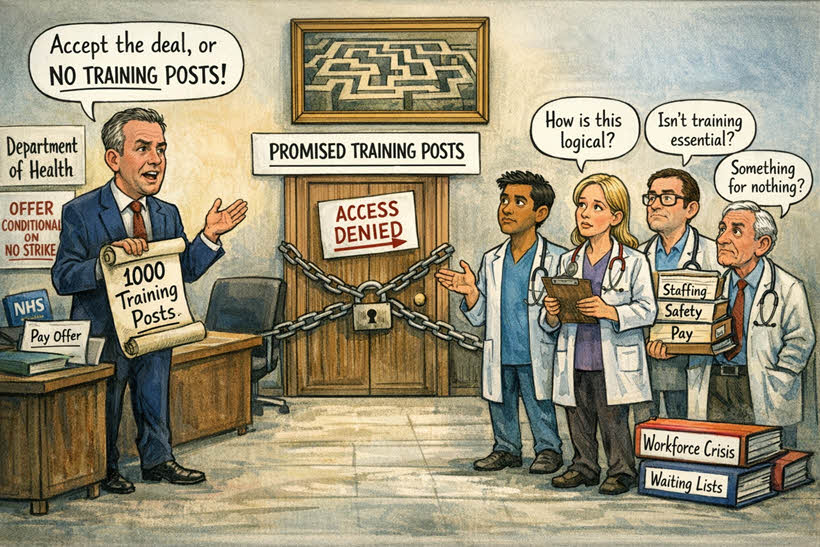
The true scale of the bill for silencing clinicians remains unknown. Despite the clear and repeated cost of this silencing, Parliament has shown little appetite to close the carved door.
Monumental resistance
Since 2020, six separate Private Members’ Bills have been introduced across both Houses of Parliament to create an independent Office of the Whistleblower – a single body with power to investigate disclosures, order redress, and protect those who speak up. Every single Bill has died. The most recent, introduced in December 2024, was scheduled for a second reading in July 2025. Parliament was prorogued. The Bill fell. The pattern is not oversight. It is a choice.
The Government’s stated position is that an Office of the Whistleblower would be “duplicative”. Duplicative of what? The Public Interest Disclosure Act 1998 provides no independent investigation. Employment Tribunals provide no remedy for the underlying wrongdoing. Prescribed regulators have no duty to protect the whistleblower. The claim of duplication is, as one parliamentary submission put it, a justification for maintaining a system that protects the institutions that caused the harm rather than the families and whistleblowers who suffer from it. The six dead Bills are a parliamentary tombstone. The carved door remains open.
What needs to change
The Settlement Agreement regime was never designed with patient safety in mind. In the NHS of 2026, where every silenced clinician can mean preventable harm, it has become a structural risk. Incremental tweaks are no longer enough.
Parliament and NHS England should mandate a national, anonymised register of all SAGs involving NHS staff. Trusts would report the number signed each year, the total public money spent, and broad categories of concern — especially those linked to patient safety or Freedom to Speak Up cases. Aggregate data should be published annually. Clinicians, regulators and the public would finally know the scale of the issue.
The 2024 NHS England policy on NDAs must become statutory and universal. It should be placed on a statutory footing, extended to all healthcare settings, and broadened to prohibit confidentiality clauses in any case involving patient safety or protected disclosures.
Procedural protections need real teeth. Introduce a statutory cooling-off period of at least 21 days. Protected conversations should be disapplied where patient-safety concerns have been raised. The “independent” legal advice requirement should be genuinely independent — either the clinician chooses their own solicitor with the Trust paying a fixed, uncapped fee from a central fund, or advice is provided through a dedicated patient-safety advocacy scheme.
These changes are not radical. They do not ban SAGs outright; they simply close the most dangerous gaps in the carved door. They would cost little compared with the human and financial price of unresolved safety issues. Most importantly, they would signal that the NHS values truth-telling over tidy exits.
The profession and its regulators face a choice. We can continue to accept a system that quietly removes the very people who speak up for safer care, or we can insist that Parliament and NHS England redesign the mechanism so that patient safety is no longer collateral damage in the pursuit of “efficient” settlements. The data black hole exists because we have chosen not to look. It is time to open our eyes. But will fear stop us from speaking up?
References
- Moore P. Whistleblower at HBOS attacks ‘ludicrously bad’ City regulators. The Guardian. 2015 Nov 14. Available from: https://www.theguardian.com/business/2015/nov/14/whistleblower-hbos-attacks-ludicrously-bad-city-regulators-paul-moore
- Great Britain. Employment Rights Act 1996, s.111A (as inserted by the Enterprise and Regulatory Reform Act 2013).
- Great Britain. Victims and Prisoners Act 2024, s.17. London: The Stationery Office; 2024. (Effective 1 October 2025 for agreements signed on or after that date.)
- Advisory, Conciliation and Arbitration Service (ACAS). Code of practice on settlement agreements. London: ACAS; 2015 [updated 2023]. Available from: https://www.acas.org.uk/code-of-practice-settlement-agreements
- Royal Devon University Healthcare NHS Foundation Trust. FOI response RDF3337-25: Use of NDAs and settlement agreements. 1 May 2025. Available from: https://www.royaldevon.nhs.uk/media/3nbhiqzx/foi-rdf3337-25-nda-s-settlement-agreements-trust-response.pdf often ‘fewer than five’ or low double-digit numbers per year”
- NHS Resolution. Annual report and accounts 2024/25. London: NHS Resolution; 17 July 2025. p. 30. (Clinical Negligence Scheme for Trusts provision as at 31 March 2025: £60.3 billion.)
- National Guardian’s Office. Culture is a patient safety issue: Annual Speaking Up data report 2024/25. London: National Guardian’s Office; 2025. Available from: https://assets.publishing.service.gov.uk/media/69242d83be88e0f89d197da2/national-guardians-office-annual-report-2024-to-2025.pdf