The intersection of political cognition and neuroscience has frequently been misread through a deterministic lens: the suggestion that ideology is ‘hardwired’ into neural architecture, thereby predetermining belief or behaviour. The empirical record, however, points in a substantively different direction. Rather than indicating that biology dictates politics, converging evidence from structural and functional neuroimaging suggests that sustained engagement with abstract, culturally constructed frameworks measurably modulates patterns of brain activation. Over time, repeated interpretive habits, attentional priorities, and social identifications appear to leave functional traces—and potentially subtle structural adaptations—in the circuits we use to navigate uncertainty, assess threat, and process social meaning. This is significant not because it reduces politics to biology, but because it demonstrates the permeability of the neural substrate to the social domain. What we repeatedly attend to, and how we frame complex information, actively tunes the brain’s predictive machinery.
Purpose & Retrieval Strategy
This entry serves as a structured learning diary rather than a public-facing exposition. Its primary utility lies in cognitive consolidation: mapping interdisciplinary connections across neuropolitics, predictive processing theory, and social cognition, then preserving them for periodic retrieval. Revisiting these notes will surface the evolution of the evidence, clarify methodological limitations, and reinforce the conceptual shift from static ‘brain types’ to dynamic, experience-dependent neuroplasticity.
Roadmap of Sections
The material that follows is organised to trace the empirical and theoretical progression of this field:
- Original neuropolitical findings – A concise review of the structural study (Kanai et al., 2011) and functional study (Schreiber et al., 2013) that first proposed measurable neural correlates of political orientation.
- Replication landscape & scientific maturation – An assessment of how larger, preregistered investigations have confirmed, qualified, or revised the original claims, with attention to effect sizes, multidimensional ideology measures, and the shift from regional activation to whole-brain network modelling.
- Reframing the question: social meaning → neural activation – A synthesis of contemporary mechanisms (predictive coding, motivated reasoning, attentional gating) that explain how top-down cognitive frameworks modulate real-time neural processing without implying biological determinism.
- Conceptual implications & personal learning notes – Reflections on dissolving the false biology/culture hierarchy, preserving agency through neuroplasticity, and integrating these insights into broader analytical or thematic work.
This introduction establishes the foundational premise: political cognition is not an external force that somehow ‘reaches down’ to activate the brain, but a specialised form of social meaning-making that continuously calibrates neural processing through repeated engagement. The sections that follow document how this understanding has been empirically grounded, methodologically refined, and conceptually clarified.
1. Original Neuropolitical Findings: Hardware & Software
The foundational work in neuropolitics emerged from two landmark studies published in quick succession. Rather than treating political orientation as a purely sociological or philosophical construct, these investigations sought to identify measurable biological correlates. The first examined static anatomical differences (‘hardware’), while the second mapped real-time neural activity during decision-making (‘software’). Together, they proposed that political leanings might be associated with distinct patterns of brain structure and function, opening an empirical pathway into how abstract ideological commitments intersect with neural architecture.
1.1 Structural Correlates: Anatomy and Political Orientation
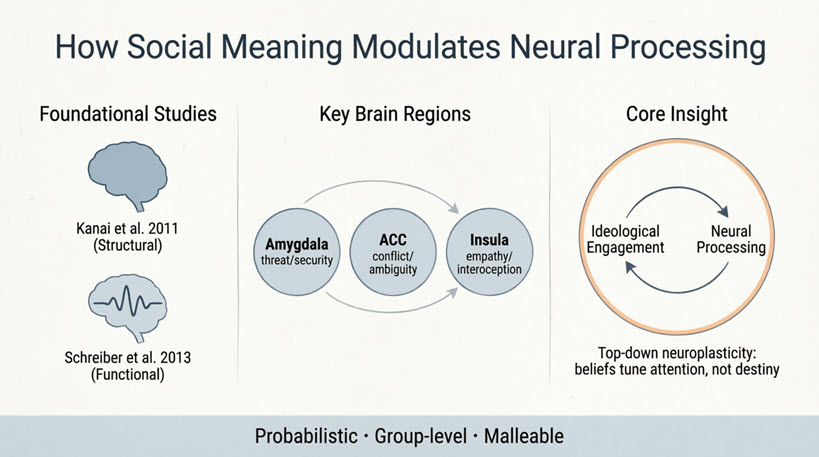
The 2011 study by Kanai et al. originated from an interdisciplinary collaboration initiated when actor Colin Firth commissioned researchers to investigate whether political attitudes corresponded to physical differences in the brain during his guest-editing tenure on BBC Radio 4’s Today programme. Using structural MRI on a sample of 90 young adults, the team measured grey matter volume across multiple cortical and subcortical regions. Two areas demonstrated statistically significant correlations with self-reported political orientation:
- Right Amygdala: Volume showed a positive correlation with conservatism. Given the amygdala’s established role in processing emotional salience, particularly threat detection and fear responses, the authors suggested that a larger amygdala might reflect heightened sensitivity to perceived danger or a stronger reliance on security-oriented social frameworks.
- Anterior Cingulate Cortex (ACC): Volume correlated positively with liberalism. As a region heavily implicated in conflict monitoring, error detection, and the processing of contradictory information, a larger ACC was interpreted as potentially supporting greater tolerance for ambiguity and a more adaptive response to complex social change.
Crucially, the researchers replicated these findings in an independent validation sample of 28 participants, reinforcing the reliability of the initial observations. However, they explicitly cautioned against causal interpretations, noting that neuroplasticity could equally explain the associations: sustained exposure to particular ideological environments might gradually reshape neural architecture over time.
1.2 Functional Divergence: Neural Pathways During Risk Assessment
Building on the structural work, Schreiber et al. (2013) shifted focus from anatomy to real-time brain activity. Using functional MRI, they examined how self-identified Democrats and Republicans processed risk during a controlled gambling task. Participants chose between a guaranteed small reward and a probabilistic larger reward, with the task carefully designed to isolate neural responses to uncertainty.
The most striking finding was behavioural equivalence: both groups exhibited nearly identical risk-taking patterns. Yet, beneath the surface, their neural activation diverged substantially:
- Republican participants demonstrated significantly heightened activity in the right amygdala during risk evaluation, aligning with the structural findings and suggesting that conservative decision-making may be filtered more heavily through threat-assessment and emotional-reactivity networks.
- Democratic participants showed elevated activation in the left posterior insula, a region associated with interoception (monitoring internal bodily states) and social cognition. This pattern implies that liberal risk evaluation may be more tightly coupled with empathetic processing and internal emotional awareness.
Remarkably, the researchers constructed a predictive model using only the fMRI data, which correctly classified participants as Democrat or Republican with 82.9% accuracy. This suggested that functional neural signatures during risk processing might serve as a robust, albeit probabilistic, marker of political affiliation.
1.3 Immediate Interpretive Limits
Despite their pioneering status, both studies carried methodological and conceptual constraints that warrant careful consideration. First, their cross-sectional designs preclude any definitive claims about causality; it remains equally plausible that ideological commitment shapes neural development as it is that neural predispositions shape ideology. Second, the reported correlations, while statistically significant, reflect group-level tendencies rather than individual determinants, and the effect sizes are modest when contextualised against the broader variance of human belief. Third, the research operated within Anglo-American two-party frameworks, utilising simplified political scales that do not neatly translate to multiparty systems or non-Western political cultures. Finally, both research teams explicitly warned against deterministic readings, emphasising that these findings describe probabilistic associations at the population level, not fixed biological destinies.
These foundational studies opened a rigorous empirical pathway into the neuropolitical domain, but they also established the need for larger samples, preregistered replications, and more nuanced conceptualisations of ideology—developments that subsequent research would directly address.
4. Conceptual Implications & Personal Learning Notes
The neuropolitical literature, when read carefully, does not reduce political belief to biological determinism. Instead, it reveals a more intricate reciprocity: the social domain is not external to the brain, but continuously embodied through it. Abstract frameworks—justice, authority, solidarity, threat—are not merely intellectual constructs; they are repeatedly enacted interpretive habits that leave measurable traces on neural processing. This section documents the conceptual shifts these studies provoke, alongside notes on how this material functions within my own learning architecture.
4.1 Dissolving the Biology/Culture Dichotomy
Traditional explanatory models often position biology and culture as separate tiers, with the former providing a fixed substrate and the latter supplying variable content. The empirical trajectory from Kanai et al. (2011) through Schreiber et al. (2013) and subsequent replication work undermines this hierarchy. The brain is not a closed biological system that occasionally receives social input; it is an organ evolved for, and fundamentally structured by, social engagement. Political cognition, therefore, should be understood as a specialised form of social meaning-making. When individuals repeatedly frame events through particular ideological lenses, they are not simply accessing pre-wired modules. They are actively calibrating predictive networks that govern attention, salience assignment, and emotional regulation. The amygdala’s heightened activation during risk assessment, or the insula’s engagement during empathetic evaluation, reflects not a static predisposition but a dynamically maintained pattern of cognitive prioritisation. In this light, the social does not ‘reach down’ to activate the brain; it becomes biological through continuous, experience-dependent interaction.
4.2 Agency, Malleability & Historicity
If neural activation patterns are shaped by sustained ideological engagement, then they remain inherently malleable. This preserves both individual agency and historical contingency. The brain’s capacity for neuroplasticity ensures that altered experiences, sustained dialogue, or critical reflection can recalibrate the very circuits that once reinforced rigid interpretive habits. Political orientation, therefore, is better conceptualised as a dynamic process rather than a fixed trait. This distinction carries significant ethical weight: neuropolitical findings describe probabilistic group-level tendencies, never deterministic individual predictions. They should not be weaponised to pathologise disagreement or to suggest that ideological divides are biologically insurmountable. Instead, they illuminate how deeply our chosen affiliations and repeated cognitive routines become embedded in our perceptual and affective lives. Recognising this embedding is the first step towards deliberate recalibration. If threat-sensitivity networks are reinforced through prolonged exposure to fear-based messaging, they can equally be modulated through practices that cultivate ambiguity tolerance, perspective-taking, and cooperative framing. The literature, at its best, points not toward fatalism, but toward the possibility of intentional cognitive and social rewiring.
4.3 Diary Context & Retrieval Strategy
This entry functions primarily as a cognitive scaffold rather than a public-facing exposition. Its structure is designed for periodic retrieval: each section maps a distinct phase of the empirical and conceptual arc, allowing future review to surface integrated understanding without requiring re-derivation of the underlying evidence. The outline deliberately moves from structural hardware to functional software, through replication maturation, into mechanistic reframing, and finally into conceptual synthesis. This progression mirrors the actual development of the field while preserving a clear line of reasoning for future reference.
When revisiting this material, the aim is to anchor three core insights:
- Neural correlates are probabilistic, not deterministic. Group-level associations do not translate to individual prediction or fixed destiny.
- Ideology tunes processing through top-down neuroplasticity. Repeated engagement with particular meaning-making frameworks gradually recalibrates attentional, emotional, and evaluative networks.
- The biology/culture boundary is permeable. Abstract social constructs become somatic through continuous brain–body–environment interaction, dissolving false hierarchies between ‘natural’ and ‘constructed’ explanations.
These notes will serve as a reference point for broader analytical work, particularly when exploring themes of identity formation, perceptual bias, moral reasoning, and the structural versus functional dimensions of human cognition. The value lies not in memorising effect sizes, but in retaining the conceptual architecture: how meaning becomes biology, how biology enables meaning, and how sustained attention shapes the very machinery of perception.