In the world of physical medicine, there is a concept known as “ground truth.” If a patient presents with chronic abdominal pain, a surgeon does not simply “divine” the presence of appendicitis based on the patient’s personality or the “vibe” of the consultation. There is a verifiable chain of evidence based on physical examination, blood markers, and imaging. If a surgeon operates on a healthy appendix because they “felt” it was diseased without proper diagnostics, they’re courting a malpractice claim.
Not everyone knows that psychiatrists are medical doctors. They are. This means that they must adhere to standards and principles of medical practice laid down by the General Medical Council. This article will show using EUPD as a diagnosis, that psychiatry has become detached from true medical practice – functioning freely in cultural comfort that it is an art more than a science. But wait – much of what is happening (or not) in EUPD diagnostics is happening across the board for other diagnoses.
In psychiatry, specifically regarding Emotionally Unstable Personality Disorder (EUPD), the chain of diagnostic evidence has effectively vanished. Over decades of observation within the clinical environment, a disturbing macroculture has emerged. We are witnessing a “national rash” of EUPD diagnoses in the UK, that appear to be conjured out of thin air. The diagnostic manuals—the ICD-10 or 11 and the DSM-5—are treated not as rigorous maps for assessment, but as ghosts: cited by name, present on the shelf, and entirely absent from the clinic.
The Illusion of Assessment
The diagnosis of personality disorder or any sub-type is a high-stakes clinical act. It is a label that fundamentally alters a person’s legal standing, their access to insurance, their treatment pathway, and their self-identity. Yet, the reality of the clinic is that “conspicuous evidence” is rarely gathered, used or produced.

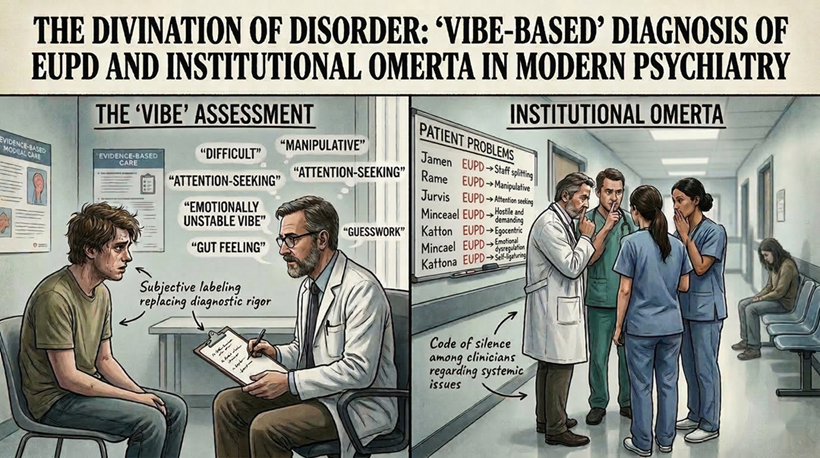
Imagine a structural engineer declaring a bridge safe because they “liked the look of the spans,” while leaving the stress-test calculations blank. This is the current state of EUPD diagnostics. It is something of a national norm for consultants conferring labels based on 20-minute crisis assessments or “impressionistic” narrative summaries. The specific, codified criteria required by the International Classification of Diseases (ICD) are bypassed in favour of “clinical intuition”—a term that has become a convenient euphemism for guesswork.
The Regulatory Veneer: GMC and RCPsych Standards
The General Medical Council (GMC) and the Royal College of Psychiatrists (RCPsych) maintain clear standards for clinical practice. The GMC’s Good Medical Practice mandates that doctors provide a good standard of practice and care, keep professional knowledge and skills up to date, and ensure that their assessments are evidence-based. The RCPsych expects consultants to use the ICD as the diagnostic standard for the UK.
However, these standards or expectations exist in a theoretical vacuum. While the RCPsych operates Quality Networks to oversee service delivery, these schemes focus on administrative compliance, staffing levels, and patient involvement rather than diagnostic validity. They audit the “wrapper” of the care ensuring forms are signed and risk assessments are present but they do not perform “diagnostic stress tests.” There is no mechanism within these networks to scrutinise whether a diagnosis was divined from thin air or derived from a conspicuous application of ICD-10 or 11 criteria.
Institutional Omerta
This lack of oversight has allowed a macroculture of institutional omerta to flourish. In any other scientific field, peer review acts as a corrective force. In psychiatry, peer review simply does not perform that function. Peer group meetings proceed in an atmosphere of professional courtesy — cases are presented, formulations are offered, heads nod. No one asks why the General Criteria for Personality Disorder were not documented and worked (a requirement of ICD-10). No one notes the absence of longitudinal evidence. The questions are never raised, not because of active suppression, but because raising them would invite the same question in return – or debates about ‘Bolam‘. When everyone in the room shares the same diagnostic habits, scrutiny becomes merely perfomative. The silence is not conspiratorial. It is structural.
The procedural failure is often more specific than it first appears. Assessments may list features drawn from the sub-criteria of EUPD — impulsivity, affective instability, self-harm — without first establishing that the General Criteria for Personality Disorder are met. This is not a minor omission. The ICD-10 requires the general criteria to be satisfied before any sub-type can be legitimately applied. To skip that step is not a diagnostic shortcut; it is a category error. In psychiatry, the documented assessment is not a record of the clinical act. It is the clinical act. Without it, the diagnosis has no substrate.
This omerta is reinforced by the way clinical notes are audited. Internal Trust audits typically look for the presence of a label, not the justification for it. If a consultant writes “EUPD” in the electronic record, it is accepted as an inertial fact. Subsequent clinicians treat the label as the starting point rather than a hypothesis to be tested. To challenge the lack of a robust ICD-10 or 11 assessment is to admit that the “emperor has no clothes”; that the diagnostic authority of the department is built on shared habits rather than clinical discipline. Consequently, the standards remain on the shelf while the “divination” continues in the clinic.
The Research Disconnect: Reality vs. The Manual
This observation is not merely a subjective frustration; it is a documented clinical reality. Research consistently shows a massive gulf between how doctors say they diagnose and what they actually do.
One of the most damning pieces of evidence comes from a study comparing routine clinical interviews to structured diagnostic assessments. In “real world” practice, psychiatrists often fail to identify personality disorders that are clearly present when measured against actual criteria, or conversely, they apply labels to individuals who do not meet the threshold [1]. When clinicians rely on ‘unstructured’ interviews — the kind seen in the vast majority of NHS clinics — inter-rater reliability, from a research perspective, drops to levels that would be considered scandalous in any other branch of medicine [2]. But research measures is different. In practice, if clinicians are uniformly applying the same flawed shorthand, their agreement proves only that the corrupt methodology is shared.
Furthermore, the “EUPD” label is frequently used as an administrative “bucket.” Large-scale audits have found that the vast majority of patients with this diagnosis are prescribed psychotropic medications for “affective dysregulation,” suggesting that the diagnosis is often reverse-engineered to justify a prescription rather than resulting from a robust assessment of personality [3].
The Rix Critique: Misperceptions and Misuse
The most significant recent exposure of this “thin air” culture is found in the work of Keith Rix. In a comprehensive analysis of how these manuals are used in legal and clinical settings, Rix confirms that the psychiatric profession is suffering from a “misperception” of its own tools [4].
Rix’s findings serve as a “smoking gun” for the argument that the ICD-11 has become a “Ghost Manual” in the UK:
- The Adherence Gap: Rix explicitly notes that practising clinicians “seldom adhere strictly to the specific diagnostic criteria” in their daily practice [4]. The rigorous application of the manual is a performance saved for the courtroom, while the clinic operates on shortcuts.
- The “Clinical Judgement” Escape Hatch: Rix highlights how the ICD-11’s own preamble—which describes the criteria as “general guidelines”—is being weaponised by clinicians to justify a total lack of rigour. If the manual is just a “guideline,” the consultant feels entitled to “divine” the diagnosis without documenting a single tick-box of evidence [4].
- The Z-Code Malpractice: Rix identifies cases where social problems—such as employment difficulties or poverty—are being rebranded as “medical conditions” using ICD codes (like Z56.0). This pathologisation of life circumstances allows clinicians to manufacture “disorders” where none exist, satisfying administrative needs while failing the patient [4].
- Spurious Certainty: The paper argues that the manuals provide a “spurious impression of certainty.” They are used to create a hard line between “normal distress” and “disorder” that has little to no scientific basis, yet carries immense legal and social weight [4].
The Legal Shield: From Bolam to Bolitho
The “divination” of EUPD is often shielded by a popular—and incorrect—interpretation of the Bolam test. Bolam v Friern Hospital Management Committee [1957] established that a doctor is not negligent if they act in accordance with a practice accepted as proper by a responsible body of medical men. In the psychiatric macroculture, where “divining” is the norm, many clinicians believe this provides a carte blanche: if everyone else is guessing, then guessing is “responsible practice.” Nonsense by any measure.
However, this ignores the vital correction provided by Bolitho v City and Hackney Health Authority [1997]. Bolitho clarified that the court can refuse to accept a professional opinion if it is not “logically defensible.” If a psychiatrist assigns a life-altering label like EUPD without a conspicuous application of the ICD-11 criteria, their opinion is not logical; it is a procedural failure. As Rix (2025) points out, the “imperfect fit” between clinical vibes and legal requirements means that a diagnosis “begs the question” of its own validity if the evidence isn’t there [4]. In short, a shared habit of poor practice is not a legal defence against the requirement for logic.
Except for the odd Mental Health Tribunal there are no courtrooms behind health service walls, to rigorously hold psychiatric diagnostics to account. So, same old.. same old will prevail!
Conclusion
The systemic lack of scrutiny in modern psychiatry has created a perfect environment for the “vibe-based” diagnosis to flourish. We are currently operating in a malpractice vacuum. By failing to audit the actual content of diagnostic logic, regulatory bodies have effectively signed off on a culture where labels are conferred rather than assessed. This is not an abstract clinical debate; it is an abandonment of the patient.
When a consultant “divines” a diagnosis, they are bypassing the only safeguard the patient has: the requirement for conspicuous evidence. If the psychiatric profession continues to treat its diagnostic manuals as optional guidelines rather than rigorous standards, it forfeits its claim to medical legitimacy. We are not just dealing with poor paperwork; we are dealing with fundamental breaches of clinical duty.
The “fundamental wrong” is that psychiatry has the power of a hard science but the accountability of an art form. Until someone in authority demands that every EUPD diagnosis is backed by a conspicuous, documented application of ICD-10 or 11 criteria—proving the patterns of behaviour, the duration, and the pervasive maladaptation—we are not practising medicine. We are practising divination. Psychiatrists need to stop institutionalised guesswork and define themselves as real doctors.
If Rix is right (and the case law suggests he is), then the diagnostic habits of NHS psychiatrists are creating a liability time bomb.
Every EUPD diagnosis made without applying ICD criteria is potentially:
- Fictions at Mental Health Tribunals or successful appeals against detention, or
- A negligence claim, and/or
- A cross-examination from hell, , and/or
- A GMC complaint
References
- Zimmerman, M., & Mattia, J. I. (1999). Differences between clinical and research diagnoses of borderline personality disorder. American Journal of Psychiatry, 156(10), 1570-1574.
- Clark, L. A., Cuthbert, B., Lewis-Fernández, R., et al. (2017). Three approaches to understanding and classifying mental disorder: ICD-11, DSM-5, and the National Institute of Mental Health’s Research Domain Criteria (RDoC). Psychological Science in the Public Interest, 18, 72-145.
- Paton, C., Crawford, M. J., Bhatti, S. F., et al. (2015). The use of psychotropic medication in people with personality disorder under the care of specialist mental health services. Journal of Clinical Psychiatry, 76(4), e512-e519.
- Rix, K. (2025). DSM and ICD classifications in medico-legal reporting: misperceptions, misunderstandings and misuse. BJPsych Advances, 32, 44-56.